
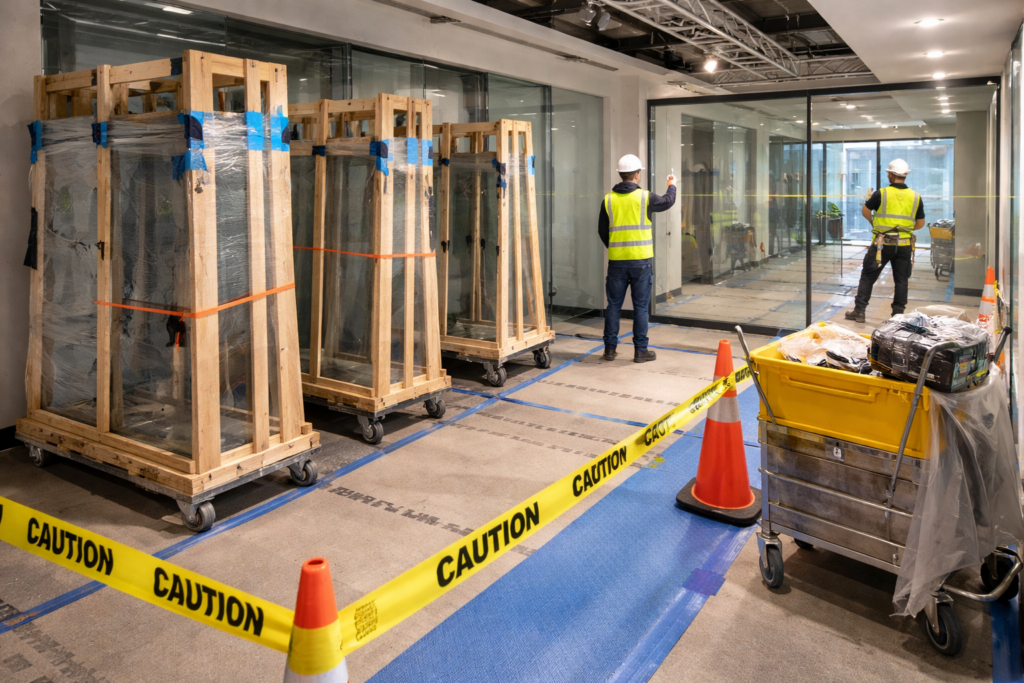
Site protection wall system installation is one of the most overlooked factors in delivering clean, damage-free architectural wall projects.
But that outcome depends heavily on something less visible: site protection.
Site protection in wall system installation isn’t just about avoiding damage. It’s about controlling risk in an environment where multiple trades, tight schedules, and high-value components all intersect. When protection is handled well, projects finish cleanly. When it’s overlooked, small issues compound quickly.
Wall System Components Are Not Forgiving
Modern modular and architectural wall systems are precise. They are designed to fit tightly, align cleanly, and present a finished look with little tolerance for error.
That precision comes with a tradeoff: components are less forgiving.
Glass panels, finished aluminum frames, and specialty hardware can be damaged easily if:
- handled with improper equipment,
- staged in high-traffic areas,
- or exposed to ongoing construction activity.
Unlike rough construction materials, these components are part of the finished product. Once damaged, they are not easily “fixed.” Replacement often means delays, reordering, and coordination headaches.
Proper Handling Equipment Is Not Optional
One of the most overlooked aspects of site protection is equipment.
Handling glass and wall system components safely requires:
- appropriate carts and dollies designed for glass transport,
- padding and protection materials,
- lifting techniques that match the weight and fragility of the components.
Without the right equipment, crews are forced into improvisation. That’s where damage tends to occur—chips, scratches, stress cracks, or impacts that aren’t visible until later.
Professional installation teams treat handling as part of the system, not an afterthought.
Staging and Storage Matter More Than People Expect
Where materials are placed on site has a direct impact on risk.
Good staging practices include:
- storing components away from active trade zones,
- keeping materials off the ground and protected from debris,
- organizing parts in install sequence to reduce unnecessary movement,
- limiting re-handling as much as possible.
Poor staging creates a different reality:
- materials get moved multiple times,
- parts are exposed to traffic from other trades,
- and accountability becomes unclear when damage occurs.
In wall system installation, every additional touchpoint increases risk.
Other Trades Are Not the Enemy—But They Are a Risk Factor
Most jobsite damage doesn’t come from the installation crew. It comes from the environment.
Electrical, HVAC, flooring, painting, and general construction work often continues around or after wall system installation. Even when everyone is doing their job correctly, overlap creates risk.
Common issues include:
- tools or ladders contacting installed panels,
- debris impacting finished surfaces,
- overspray or dust affecting glass and frames,
- trades working in spaces that should be protected.
This isn’t about blame. It’s about timing and coordination.
Scheduling Is One of the Most Effective Forms of Site Protection
One of the simplest ways to reduce damage risk is proper sequencing.
Wall systems should be installed:
- after major overhead work is complete,
- after messy trades have finished their primary scope,
- and at a point where the environment is stable enough to protect finished components.
When installation happens too early:
- walls become obstacles for other trades,
- protection becomes harder to maintain,
- and the likelihood of damage increases significantly.
Scheduling isn’t just about efficiency—it’s a core part of site protection.
Cleanliness Is a Risk-Control Tool
Clean jobsites are not just about appearance. They directly affect installation quality and component safety.
A clean environment:
- reduces the chance of debris scratching surfaces,
- improves visibility for precise alignment,
- and makes it easier to identify issues early.
A cluttered or dirty site:
- increases handling errors,
- hides potential hazards,
- and creates unnecessary friction between trades.
In high-precision installations, cleanliness supports accuracy.
Site Protection Is Ultimately About Control
All of these factors—handling, staging, coordination, scheduling, and cleanliness—point to a single idea:
Site protection is about control.
Control of:
- the environment,
- the sequence of work,
- the number of times materials are handled,
- and the interaction between trades.
When control is maintained, installation proceeds smoothly. When it’s not, the project becomes reactive.
What This Means for Dealers and Project Teams
For furniture dealers and project managers, site protection should be part of the installation conversation early—not something addressed after issues appear.
Practical steps include:
- confirming the installer’s handling and staging approach,
- aligning installation timing with other trades,
- ensuring staging areas are defined and protected,
- and reinforcing expectations around site cleanliness and coordination.
These are small inputs that produce outsized results.
Final Thoughts
Architectural wall systems are designed to deliver clean, precise, and durable results. Achieving that outcome depends on more than installation skill alone.
It depends on how well the jobsite is protected.
Site protection in wall system installation is not a secondary concern. It’s a fundamental part of delivering a project that looks as good at completion as it did on paper.
In an environment where the final result is highly visible—and difficult to repair once compromised—that level of discipline makes all the difference.